Headder AdSence

Showing posts with label dbt. Show all posts

dbt Performance Optimization Techniques

dbt Performance Optimization Techniques

Explore essential dbt performance optimization techniques for faster data transformation.

Introduction to dbt Performance Optimization

In the world of data engineering, performance optimization is crucial for efficient data transformation.

This guide will explore various techniques to optimize dbt models and improve query performance.

  • Understand how dbt compiles SQL.
  • Leverage incremental models for large datasets.
  • Use materializations wisely.

Apply these techniques to enhance your dbt workflows.

Understanding dbt Compilations

Dbt compiles SQL based on your project structure and model definitions, which affects performance.

Understanding how dbt compiles your models can help in structuring them efficiently.

Using Incremental Models

Incremental models only process new or updated records, significantly reducing the processing time for large datasets.

Define unique keys and conditions for effective incremental loading.

Materialization Strategies

Choosing the right materialization strategy (table, view, incremental) can impact performance.

Use views for frequently changing data and tables for static datasets.

Optimizing SQL Queries

Write efficient SQL queries using CTEs and subqueries to minimize data processing time.

Utilize dbt's Jinja templating to create reusable query components.

Quick Checklist

  • Identify slow-running models for optimization.
  • Experiment with different materialization strategies.
  • Monitor query performance in your data warehouse.

FAQ

What is dbt?

dbt (data build tool) is a command-line tool that enables data analysts and engineers to transform data in their warehouse more effectively.

How does incremental loading work in dbt?

Incremental loading in dbt allows you to only process new or modified records, speeding up the transformation process.

What are materializations in dbt?

Materializations define how dbt creates tables or views in your data warehouse, impacting performance and storage.

Related Reading

  • dbt Documentation
  • Data Warehouse Optimization Techniques
  • Best Practices for SQL Performance

This tutorial is for educational purposes. Validate in a non-production environment before applying to live systems.

Tags: dbt, performance, optimization, data engineering, BI
Airflow Orchestration: Integrating Airflow with dbt

Airflow Orchestration: Integrating Airflow with dbt

Learn how to integrate Apache Airflow with dbt for efficient data orchestration.

Introduction to Airflow and dbt Integration

Apache Airflow is a powerful tool for orchestrating complex data workflows, while dbt (data build tool) is designed for transforming data in your warehouse. Integrating these two tools allows data engineers to create robust data pipelines that are easy to manage and scale.

This tutorial will guide you through the steps needed to connect Airflow with dbt, enabling you to automate your dbt tasks as part of your data workflow.

Ensure you have both Airflow and dbt installed before proceeding.

Setting Up Airflow and dbt

Before integrating Airflow with dbt, you need to set up both tools. Install Apache Airflow and dbt, and configure your dbt project.

Use the following commands to install dbt:

pip install dbt

Then, initialize your dbt project using:

dbt init my_project

Check the official documentation for specific installation instructions.

Creating Airflow DAG for dbt

In Airflow, create a Directed Acyclic Graph (DAG) that defines the workflow for running dbt commands.

Import the necessary operators from Airflow, such as BashOperator, to execute dbt commands.

Refer to the Airflow documentation for best practices on creating DAGs.

Testing the Integration

Once your DAG is set up, test the integration by triggering the DAG manually in Airflow.

Monitor the logs to ensure that the dbt commands are executed successfully.

Use the Airflow web interface to monitor task execution.

Quick Checklist

  • Install Apache Airflow
  • Install dbt
  • Create a dbt project
  • Set up Airflow DAG
  • Test the integration

FAQ

What is Apache Airflow?

Apache Airflow is an open-source platform to programmatically author, schedule, and monitor workflows.

What is dbt?

dbt is a command-line tool that enables data analysts and engineers to transform data in their warehouse.

How do I schedule dbt runs in Airflow?

You can schedule dbt runs by creating a DAG in Airflow that includes tasks for executing dbt commands.

Related Reading

  • Data Pipeline Best Practices
  • Introduction to dbt
  • Understanding Apache Airflow

This tutorial is for educational purposes. Validate in a non-production environment before applying to live systems.

Tags: Airflow, dbt, Orchestration, Data Engineering, ETL

📝 Module 1: What Is dbt and Why Should You Learn It in 2025?

What Is dbt? A Beginner’s Guide to Modern Data Transformation in 2025

🧠 Introduction

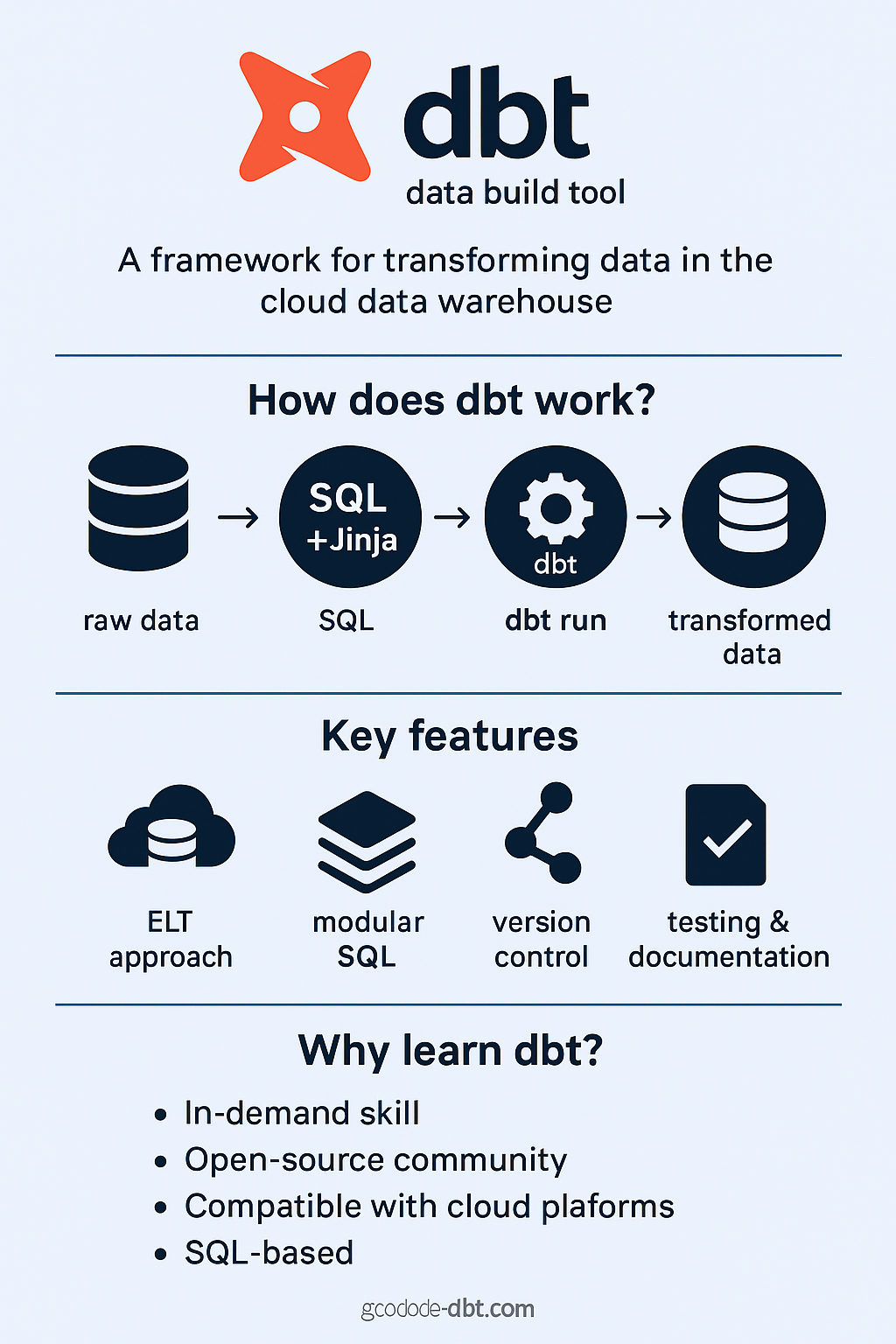
If you're a data engineer, analyst, or BI developer wondering how to stay relevant in the fast-changing data world, dbt (data build tool) is the tool you need to know. It’s cloud-native, developer-friendly, and built to transform raw data into trusted, analytics-ready datasets — with just SQL and a touch of Jinja.

This module introduces you to what dbt is, why it's different from traditional ETL tools like SSIS or Informatica, and how it fits into the modern data stack.


🚀 What Is dbt?

dbt = Transform + Test + Document your data using only SQL.

  • It’s an ELT (not ETL) framework: Load first, transform later.
  • Works with modern cloud warehouses: Snowflake, BigQuery, Redshift, Databricks, etc.
  • Uses modular SQL models that build on top of each other.
  • Integrates easily with version control (Git) and CI/CD.
  • Offers built-in testing, documentation, and lineage visualization.

🔧 What Makes dbt Different?

Feature

Traditional ETL

dbt

Tech

GUI or scripts

SQL + Jinja

Code reuse

Limited

Modular, reusable models

Deployment

On-premise or heavy cloud

Lightweight CLI or dbt Cloud

Version Control

Manual or complex

Git-native

Testing

Manual

Built-in

Documentation

External

Auto-generated

Community

Closed

Huge open-source community


🏗️ dbt Workflow (Simplified)

  1. Write modular SQL in /models
  2. Use Jinja to parameterize and reuse logic
  3. Run dbt run to execute transformations
  4. Add dbt test to validate data
  5. Use dbt docs to auto-generate project documentation

🎯 Why Learn dbt in 2025?

  • 🔥 Industry trend: dbt is a key tool in the modern data stack
  • 📈 Career boost: Increasingly required in data engineering & analytics roles
  • 🧱 Open standard: Works with most modern warehouses (Snowflake, BQ, Redshift)
  • 🤖 Compatible with AI tools: Easy to automate with Copilot, ChatGPT, etc.

📘 Real-World Use Cases

  • Create a sales dashboard model for Power BI
  • Build modular KPI layers like revenue, churn, retention
  • Apply data quality checks with dbt test
  • Auto-generate lineage graphs for compliance and visibility

💡 Pro Tip for Beginners

You don’t need to be a Python expert or DevOps guru. If you know basic SQL, you can start using dbt today.


📌 What’s Next?

📍 Next Module: Installing dbt CLI on Your System (Windows, Mac, Linux)
We’ll set up your first dbt project and walk through the folder structure.


dbt vs SSIS: Which ETL Tool Should You Learn in 2025?

🧠 Introduction

As the data world rapidly shifts to the cloud, traditional tools like SSIS (SQL Server Integration Services) are being challenged by newer, modern frameworks like dbt (data build tool). If you're wondering which one to invest your time in for 2025 and beyond — this post will break it down for you.

Whether you're a BI developer, data engineer, or transitioning from on-prem to cloud, here's a clear comparison of dbt vs SSIS — including strengths, weaknesses, use cases, and career impact.


🔍 What Is SSIS?

SSIS is a visual, on-premise ETL tool from Microsoft, widely used in enterprise environments for:

  • Data extraction, transformation, and loading

  • Workflow orchestration

  • Integration with SQL Server

💡 Best for: On-premise systems, legacy SQL Server-based BI environments


🔍 What Is dbt?

dbt is a modern, open-source ELT framework that helps you transform raw data into models using SQL — in the cloud.

  • Built for modern warehouses like Snowflake, BigQuery, Redshift

  • Uses SQL + Jinja templating

  • Follows software engineering best practices (CI/CD, versioning, modularity)

💡 Best for: Cloud data engineering, analytics engineering, modern stack


⚖️ dbt vs SSIS: Feature Comparison

FeaturedbtSSIS
Tool TypeELT (Transform)ETL (Extract → Transform → Load)
UICode-first (SQL + Jinja)GUI-based drag-and-drop
DeploymentCloud-nativeOn-premise (mostly)
PerformanceScales with cloud warehouseLimited to server setup
Version ControlGit-nativeDifficult to manage
CommunityLarge & fast-growingMature but shrinking
Learning CurveSteeper (SQL + CLI)Easier for beginners
Schedulingdbt Cloud, Airflow, CI/CDSQL Server Agent
CostOpen-source, SaaS (paid)Comes with SQL Server license

🎯 Use Case Examples

  • Use SSIS if:

    • You’re heavily invested in Microsoft SQL Server

    • Your data isn’t moving to the cloud yet

    • You’re dealing with file-based ETL or flat file loads

  • Use dbt if:

    • You’re working with Snowflake, BigQuery, Redshift

    • You want reproducible, testable, version-controlled transformations

    • You need scalable, cloud-first architecture


📈 Career Impact: Which Should You Learn in 2025?

RoleRecommendation
BI Developer (MS Stack)Learn both, start adding dbt
Cloud Data Engineerdbt is must-know
Legacy SSIS DeveloperTime to upskill into dbt
Entry-Level EngineerStart with dbt — future-proof your skills

🔥 Tip: Knowing both makes you a highly versatile hybrid BI/Data Engineer.


💡 Pro Tips

  • You can modernize SSIS pipelines using Azure Data Factory + dbt

  • Use dbt with Git + dbt Cloud for production-scale deployments

  • Combine dbt + orchestration tools like Airflow, Prefect, or Azure Data Factory for full control


🧭 Conclusion

In 2025, SSIS is still useful in legacy systems, but dbt is the future of data transformation. If you're planning to grow in the cloud data space, learning dbt is not optional — it’s essential.

Start with dbt's CLI, try a Snowflake model, and build your way toward modern data engineering.